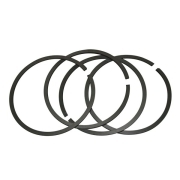
Kaxite Sealing manufactures PTFE rings by precision machining from virgin PTFE, modified TFM and filled PTFE compounds — glass, carbon-graphite, bronze and MoS2. Three configurations cover static face and radial sealing (O-ring), dynamic reciprocating and rotary sealing (piston ring), and anti-extrusion at high pressure (back-up ring). Inner diameter 3–600 mm, cross-section 1.5–20 mm, tolerances to DIN 3771 and AS568. Service range -200 to +260 °C, chemical resistance pH 0–14, dielectric strength above 60 kV/mm. FDA, RoHS and REACH certified, with USP Class VI on request. Free samples, bulk wholesale and 7–15 day lead times.
Each configuration is engineered for a distinct combination of static or dynamic service, pressure class and gland geometry. Use this guide to shortlist the right profile before requesting a quotation.
Precision-machined virgin, modified TFM or 15% glass-filled PTFE. Used for static face and radial sealing, or as back-up rings behind elastomer O-rings in aggressive chemistry. Unlike elastomer seals, does not swell, harden or degrade.
Dynamic reciprocating and rotary sealing for compressors, hydraulic cylinders and pumps. Self-lubricating and oil-free — ideal for dry-running service where oil carry-over is unacceptable. Filled grades for high PV.
Rectangular or K-shaped section installed behind an elastomer O-ring to prevent extrusion at high pressure. Raises static pressure capability to 400 bar. Available in virgin or bronze-filled PTFE for high-load duty.
Each grade is engineered for a distinct combination of chemical resistance, wear resistance, PV capability and thermal conductivity. Use this guide to shortlist the right compound before requesting a quotation.
100% unfilled PTFE. Maximum chemical purity, best dielectric properties and lowest friction. FDA compliant for direct food and pharmaceutical contact.
Food & Beverage · Pharmaceutical · Semiconductor · High-Purity Chemical
Improved compression resistance, reduced creep, higher stiffness and better wear resistance. Standard choice for static and slow dynamic seals.
Static & Slow Dynamic Seals · Pump Housings · Heavy-Duty Flanges
Enhanced thermal conductivity, improved wear resistance and static dissipation. Excellent PV limit for high-speed and high-load service.
Wear Rings · Bearing Pads · Compressor Rings · Heat Dissipation
Superior wear resistance, high thermal conductivity and excellent load-bearing capacity. Ideal for high-load piston and thrust applications.
Piston Rings · Thrust Washers · Bushings · High-Load Bearing
Lower coefficient of friction, improved extrusion resistance and enhanced lubricity. Ideal for dry-running and vacuum service where oil is prohibited.
Dry-Running Seals · Gas Service · Vacuum Applications
Six industries where virgin or filled PTFE rings replace elastomer, metal or graphite seals in static, dynamic and anti-extrusion duty.
Reactor seals, pump housings and valve stems handling aggressive acids, alkalis and solvents. Pairs with our PTFE ring gaskets for flange joints.
Pure-media fluid sealing requiring FDA 21 CFR and USP Class VI compliance with zero extractables. See our pure PTFE gaskets for hygienic flanges.
Dry-running compressors, hydraulic cylinders and plunger pumps. Carbon or bronze-filled piston rings for high PV and load. Pairs with our PTFE packing for combined dynamic sealing.
High-purity gas delivery, vacuum pumps and UPW distribution systems where ultra-low extractables and dimensional stability matter. Pairs with our PTFE tubes for full flow-path sealing.
Wellheads, Christmas trees and sour-service valve seals where metal and elastomer seals corrode. Pairs with our modified PTFE gaskets for high-pressure sealing.
Valve stems, pump shafts, mechanical seals and chevron packing assemblies. Virgin PTFE grades for zero-contamination service. Pairs with our PTFE flexible tubing in sampling lines.
| Property | Test Standard | Typical Value (Virgin PTFE) | Notes |
|---|---|---|---|
| Density | ASTM D792 | 2.15 – 2.20 g/cm³ | High purity, consistent material |
| Tensile Strength | ASTM D638 | 25 – 35 MPa | Adequate mechanical strength for sealing |
| Elongation at Break | ASTM D638 | 300 – 500% | Excellent ductility and creep resistance |
| Compression Set (22h @ 25°C) | ASTM D395 | 40 – 60% | Improved with filled compounds |
| Coefficient of Friction (Dynamic) | ASTM D1894 | 0.05 – 0.10 | Exceptionally low, reduces stick-slip |
| Continuous Service Temperature | — | -200 to +260 °C | Widest range of any common polymer |
| Dielectric Strength | ASTM D149 | >60 kV/mm | Superior electrical insulation |
Universal chemical resistance and an extremely wide temperature range. While elastomers like FKM offer good chemical resistance to specific fluids, PTFE is resistant to nearly all. PTFE does not swell or degrade in harsh chemicals and performs from deep cryogenics to high heat, where most elastomers fail. Its low friction and non-stick properties are also unique benefits.
Yes, but with considerations. Virgin PTFE has a relatively high wear rate and cold flow under constant load. For dynamic applications, filled grades such as our KX-PTFE-G25 (glass-filled) or KX-PTFE-C20 (carbon-filled) are strongly recommended — they improve wear resistance, reduce creep, and enhance the ability to handle pressure-velocity (PV) loads. Proper gland design and surface finish are also critical.
Choose virgin PTFE (KX-PTFE-V) when maximum chemical purity, FDA compliance or excellent dielectric properties are paramount — food, pharma or electrical. Opt for a filled compound when you need enhanced mechanical properties: improved wear resistance (glass or carbon fillers), reduced creep (glass or bronze), higher thermal conductivity (carbon or bronze), or anti-static properties (conductive carbon).
Absolutely. This is one of PTFE's greatest strengths. It is highly resistant to virtually all industrial chemicals, including concentrated sulfuric acid, nitric acid, caustic soda, hydrocarbons, ketones, alcohols and chlorinated solvents. Always confirm compatibility with specific media at elevated temperatures and pressures, though instances of PTFE attack are extremely rare.
PTFE has a higher initial cost than many elastomers. It is not elastic like rubber; it seals through viscoelastic flow and requires precise gland design. Its wear resistance in pure form is moderate, necessitating filled grades for dynamic use. It also has a relatively high coefficient of thermal expansion and can creep under sustained load — mitigated by proper fillers and gland design.
Yes, custom manufacturing is a core strength. We routinely produce non-standard cross-sections, complex geometries, large diameters and micro-miniature seals — from custom gaskets for unique flanges to specialized wear bands or prototype seals. Simply provide a detailed drawing or sample and we will provide a solution within 24 hours.
Send us your configuration (O-ring, piston ring or back-up ring), inner diameter, outer diameter, cross-section, tolerance, operating temperature, media, static or dynamic service and grade preference — or a finished-part drawing. Our export team replies within 24 hours and confirms grade selection, lead time, packaging and documentation before you place a bulk order.