What is a PTFE O-ring? It is a torus-shaped sealing element made from polytetrafluoroethylene resin, often reinforced with fillers, designed to fit into a groove and compress between two mating surfaces. For procurement professionals working in chemical processing, pharmaceutical manufacturing, food-grade systems, or oil and gas, a failed O-ring is not just a component replacement cost—it can shut down a clean-in-place cycle, contaminate a batch, or create a safety incident. Many buyers discover that standard NBR, EPDM, or FKM rings swell, harden, or crack when exposed to aggressive solvents, strong acids, steam, or extreme temperatures. PTFE O-rings address these failure modes because they deliver near-universal chemical resistance, a wide operating temperature range, and low friction. They can be machined from virgin PTFE or filled PTFE compounds to improve creep resistance and pressure handling. Understanding what a PTFE O-Ring is and where it outperforms elastomers helps you write tighter RFQs, avoid field failures, and reduce total cost of ownership. This guide gives you a practical, buyer-focused overview of material choices, sizing, installation, and supplier qualification.
Picture a chemical transfer line running methyl ethyl ketone at 60°C. A plant engineer chooses a standard FKM O-ring because the datasheet says it resists many solvents. Within days, the ring swells, softens, and begins to extrude from the groove. The leak triggers unplanned downtime and a costly line flush. This is a familiar scenario for procurement teams that source elastomer O-rings for broad chemical service. NBR works well in oils but struggles with strong acids and polar solvents. EPDM is excellent in hot water and steam but fails in petroleum-based fluids. FKM may tolerate many chemicals but degrades in ketones, amines, and hot acids. Each failure mode has a common root: the elastomer network absorbs the chemical, swells, loses compression set, or thermally degrades.
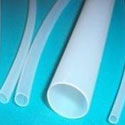
PTFE O-rings change the equation. Polytetrafluoroethylene is essentially chemically inert across a pH range from 0 to 14, with no significant reaction to most solvents, acids, bases, fuels, and process fluids. Unlike rubber, PTFE does not swell or soften because there is no cross-linked elastomer network to attack. This reduces unplanned maintenance and makes seal selection more predictable. The image below shows a machined PTFE O-ring ready for chemical service.

| Material | Chemical resistance | Typical failure mode | Continuous temp range |
|---|---|---|---|
| NBR | Good in oils; poor in strong acids, polar solvents | Swelling, cracking, hardening | -30°C to 100°C |
| EPDM | Excellent in hot water, steam; poor in oils | Softening, extrusion in petroleum fluids | -40°C to 150°C |
| FKM | Broad but poor in ketones, amines, hot acids | Swelling, shrinkage, thermal degradation | -20°C to 200°C |
| PTFE | Near-universal; inert to most chemicals | Creep under extreme load if not filled | -200°C to 260°C |
At a pharmaceutical plant, a vacuum dryer seals a vessel handling methylene chloride and heated water for cleaning. The maintenance team replaces EPDM O-rings every three months because they swell in solvent service and then crack during steam cleaning. The repeated replacement cost is acceptable, but the real risk is product contamination and batch rejection.
A switch to PTFE O-rings eliminates the swelling and cracking cycle. Virgin PTFE is FDA-compliant for food and pharmaceutical contact in many grades and can withstand both solvent exposure and steaming. Because PTFE has a low coefficient of friction, it also reduces sticking during lid movement. For vacuum or dynamic service, filled PTFE O-rings with glass or carbon improve dimensional stability and reduce cold flow. Ningbo Kaxite Sealing Materials Co., Ltd. supplies both virgin and filled PTFE O-rings with surface finish control that helps prevent microbial buildup in hygienic applications.
| Parameter | Virgin PTFE | 15% glass-filled PTFE | 25% carbon-filled PTFE |
|---|---|---|---|
| Temperature range | -200°C to 260°C | -200°C to 260°C | -200°C to 260°C |
| Hardness, Shore D | 50–60 | 60–65 | 60–65 |
| Chemical compatibility | Excellent | Excellent; slightly reduced in some strong alkalis | Excellent |
| Creep resistance | Moderate | Improved | Good |
| Common use | Food, pharma, low-load static | Chemical pumps, flanges | Dynamic seals, water service |
Sourcing engineers often ask for “a PTFE O-ring” without specifying filler content. The quote they receive may be for virgin PTFE, but the application may involve high-pressure flanges where virgin PTFE will deform and leak after thermal cycling.
Choosing the right PTFE compound is a decision based on pressure, temperature cycling, and movement. Virgin PTFE offers maximum purity and chemical inertness. Glass-filled PTFE improves compressive strength and reduces deformation under load. Carbon-filled PTFE enhances wear resistance and is often used in dynamic applications. Stainless steel-filled PTFE provides excellent extrusion resistance in high-pressure flanges. A small addition of molybdenum disulfide can improve sliding behavior in vacuum or dry-running conditions. Ningbo Kaxite Sealing Materials Co., Ltd. can recommend the most cost-effective compound after reviewing your service medium and operating envelope.
| PTFE compound | Filler content | Benefits | Limitations | Typical applications |
|---|---|---|---|---|
| Virgin PTFE | None | Highest purity, FDA grades, full chemical inertness | Creeps under high load | Food, pharma, low-pressure static |
| Glass-filled PTFE | 15% or 25% glass fiber | Better compression set, lower creep | Slightly abrasive to mating surfaces | Flanges, pumps, valves |
| Carbon-filled PTFE | 25% carbon | Improved wear, good thermal conductivity | Not for oxygen service | Dynamic sealing, compressors |
| Stainless steel-filled PTFE | 50% SS | High extrusion resistance | Harder, requires higher load | High-pressure flanges |
A buyer in a pump manufacturing plant orders a 100 mm PTFE O-ring by inner diameter only. When the ring arrives, it cannot be stretched onto the piston because PTFE is much stiffer than rubber and has very little elasticity. The ring cracks during installation.
PTFE O-rings are usually machined or molded to the final groove dimensions. They are not designed to be stretched like elastomer O-rings. Always specify the exact inner diameter, cross-section, and groove width or provide a drawing. For static flange seals, the groove fill should typically be 70–85% to allow thermal expansion and pressure relief. For dynamic seals, a lower fill and careful surface finish are required. Pressure limits depend on hardness, fillers, and groove clearance. In high-pressure gas service, consider anti-extrusion backup rings.
| Standard / dimension | Cross-section range | Groove fill recommendation | Pressure limit without backup ring |
|---|---|---|---|
| AS568 (inch) | 1.78 mm–6.99 mm | 70–85% | Up to 500 psi static |
| Metric ISO 3601 | 1.80 mm–5.70 mm | 70–85% | Up to 5 MPa static |
| JIS B 2401 | 1.9 mm–5.7 mm | 70–80% | Up to 3 MPa dynamic |
| Custom machined | Any above 1.5 mm | Engineer-specified | Higher with backup ring or filled PTFE |
A field technician uses a flat-head screwdriver to press a PTFE O-ring into a tight groove. The tool slips and cuts the surface. The seal passes initial hydrotest but fails after two weeks because the cut propagates under thermal cycling.
PTFE O-rings must be handled with plastic or wooden tools, not sharp metal edges. Clean the groove thoroughly, inspect for burrs, and avoid twisting the ring during installation. Lubrication with a compatible thin grease can ease assembly, but confirm chemical compatibility. For hard filled PTFE grades, warming the ring slightly or using a tapered installation sleeve may be necessary. Never force a PTFE O-ring to stretch; specify the correct size instead. Ningbo Kaxite Sealing Materials Co., Ltd. packages PTFE O-rings in protective trays to reduce damage during transit and provides installation guidance with each order.
| Installation step | Do | Don't |
|---|---|---|
| Groove preparation | Clean, deburr, dry | Leave dirt or old seal remnants |
| Tool selection | Use plastic, brass, or rounded tools | Use sharp steel screwdrivers |
| Ring handling | Support the ring evenly | Stretch or twist excessively |
| Lubrication | Use compatible thin grease | Use silicone oil if incompatible |
A: What is a PTFE O-ring? It is a static or dynamic sealing ring produced from polytetrafluoroethylene, a fluoropolymer known for outstanding chemical resistance. FKM and NBR O-rings are rubber-based and rely on elasticity to seal, but they can swell, harden, or dissolve in aggressive fluids. PTFE O-rings are rigid compared with rubber, often machined to exact size, and resist nearly all chemicals. This makes them ideal for severe chemical, high-temperature, and high-purity services where elastomers would fail prematurely.
A: Yes, a PTFE O-ring can handle saturated steam up to about 260°C and most aggressive solvents, but the system design must control clearance and extrusion gap. In high-pressure steam or solvent service, specify a filled PTFE grade or use PTFE with an anti-extrusion backup ring to prevent cold flow. This combination works well because PTFE remains chemically stable and does not hydrolyze in steam, unlike many elastomers that soften and lose sealing force. Ningbo Kaxite Sealing Materials Co., Ltd. can help you select the right filled compound and groove clearance for combined steam and solvent exposure.
A purchasing team at a valve manufacturer sources “PTFE O-rings” from an online marketplace. The rings arrive without certificates, with wide dimensional variation, and with rough surface finish. The customer rejects the shipment and the valve line faces production delays.
The best way to avoid this is to qualify the PTFE O-ring supplier before placing a purchase order. Ask for material certificates, dimensional inspection reports, hardness data, and batch traceability. Check whether the factory can supply virgin PTFE, filled PTFE, PTFE encapsulated O-rings, and custom sizes. Ningbo Kaxite Sealing Materials Co., Ltd. provides full supply-chain transparency, in-house machining capability, and export packaging designed to protect each ring. This reduces incoming inspection time and improves line reliability.
| Supplier check | Why it matters | What to request |
|---|---|---|
| Material certification | Confirms PTFE grade and filler content | COA, FDA or RoHS where applicable |
| Dimensional tolerance | Prevents installation and leakage issues | Inspection report per lot |
| Surface finish | Affects sealing and cleanability | Ra value or visual standard |
| Batch traceability | Supports recall and quality audits | Lot numbers on packaging |
Need a reliable PTFE O-ring source for aggressive chemicals, high temperature, or hygienic service? The sealing team at Ningbo Kaxite Sealing Materials Co., Ltd. can help you evaluate material grade, dimensions, and filler options before you commit to bulk purchasing. We supply virgin and filled PTFE O-rings, PTFE encapsulated O-rings, and custom machined seals with full traceability. For a prompt quote, technical drawing review, or free sample request, contact us at [email protected].
Smith, J. A., & Liu, W., 2021, “Chemical resistance of PTFE O-rings in mixed solvent environments”, Journal of Applied Polymer Science, 138(24), 50567.
Chen, R., Patel, K., & Gonzalez, M., 2020, “Creep behavior of filled PTFE seal rings under compression”, Polymer Testing, 89, 106579.
Kumar, S., & White, T., 2019, “Friction and wear of carbon-filled PTFE O-rings in dry sliding applications”, Tribology International, 139, 55-63.
Baker, D. L., 2022, “Sealing performance of PTFE encapsulated O-rings in high-pressure hydrogen service”, International Journal of Hydrogen Energy, 47(11), 7312-7320.
Muller, H., & Zhao, X., 2018, “Effect of glass fiber filler on the extrusion resistance of PTFE O-rings”, Journal of Fluorine Chemistry, 211, 24-31.
Harrison, P., & Ng, E., 2021, “Thermal cycling performance of PTFE O-rings in steam service”, Sealing Technology, 2021(3), 8-14.
Rossi, A., & Tanaka, Y., 2020, “Comparison of virgin and stainless steel-filled PTFE O-rings for flange sealing”, Materials Chemistry and Physics, 241, 122383.
Lee, C. H., & Johnson, R., 2019, “Surface finish effects on leakage of machined PTFE O-rings”, Wear, 426-427, 1400-1408.
Fernandez, L., & Singh, A., 2022, “Compatibility of PTFE O-rings with CIP detergents and steam in pharmaceutical equipment”, Chemical Engineering Science, 253, 117563.
Wang, B., & Morris, J., 2021, “Long-term compression set of filled PTFE O-ring materials”, Polymer Degradation and Stability, 184, 109456.